
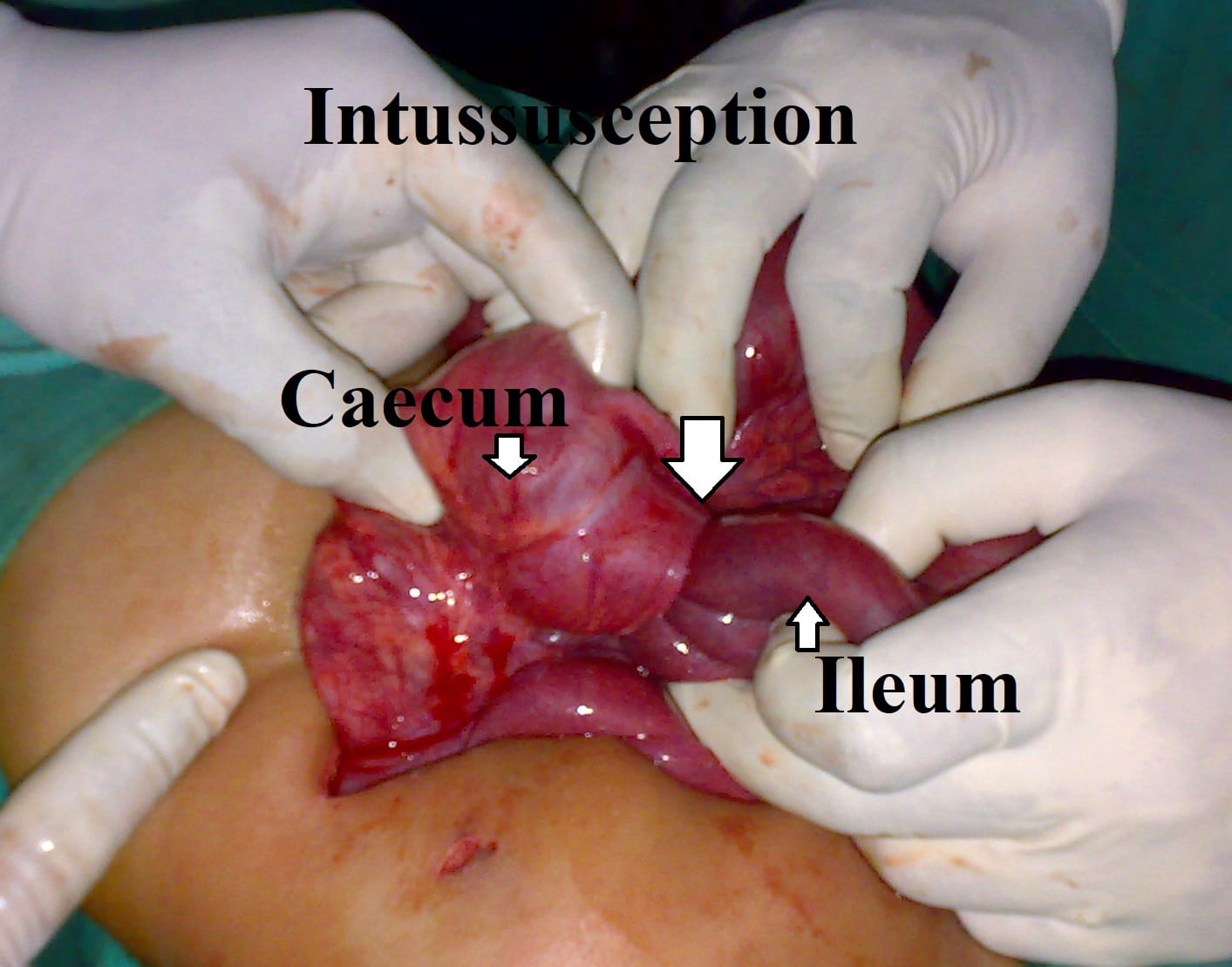
Intussusception
What is intussusception?
Intussusception is the most common cause of intestinal obstruction in children between ages 3 months and 3 years old. Intussusception occurs when a portion of the intestine folds like a telescope, with one segment slipping inside another segment. It can occur in the colon, the small bowel, or between the small bowel and colon (most common). The result can be a blocked small bowel or colon. This causes an obstruction, preventing the passage of food that is being digested through the intestine.
The walls of the 2 "telescoped" sections of intestine press on each other, causing irritation and swelling. Eventually, the blood supply to that area is cut off, which can cause damage to the intestine.
What are the causes?
The cause of intussusception is not known.
Though rare, an increased incidence of developing intussusception may be seen in children:
- Who have abdominal or intestinal tumours or masses
How often does it occur?
Intussusception is rarely seen in newborn infants. Although most of the children who develop the condition are less than 3 years old, intussusception can also occur in older children, teenagers, and adults.
Intussusception occurs more often in boys than girls.
How serious is it?
Intussusception is a life-threatening illness. If left untreated, it can cause serious damage to the intestines, since their blood supply is cut off. Intestinal infection can occur, and the intestinal tissue can also die. Untreated intussusception can also cause internal bleeding and a severe abdominal infection called peritonitis.
What are the symptoms?
The most common symptom of intussusception is sudden, loud crying caused by an onset of intermittent abdominal pain in a previously well child. However, each child may experience symptoms differently. The pain may be mistaken for colic at first, and occurs at frequent intervals. Infants and children may strain, draw their knees up, act very irritable, and cry loudly. The child may recover and become playful in-between bouts of pain or may become tired and weak from crying.
Vomiting may also occur with intussusception, and it usually starts soon after the pain begins.
Your child may pass a normal stool, but the next stool may look bloody. Further, a red mucus or jelly-like stool is usually seen with intussusception.
Symptoms of intussusception, such as fever, lethargy, bilious (yellow/green) vomiting, diarrhoea, sweating, dehydration, and an abdominal distention or lump, may resemble other conditions or medical problems. Please consult your child's doctor for a diagnosis.
How is it diagnosed?
A doctor will obtain a medical history and perform a physical examination of your child. Imaging studies are also done to examine the abdominal organs, and may include:
- Abdominal X-ray. A diagnostic test that may show intestinal obstruction.
- Ultrasound. A diagnostic imaging technique, in most cases this investigation gives almost 100% diagnosis.
What is the treatment?
Specific treatment for intussusception will be determined by your child's doctor based on the following:
- The extent of the problem
- The health of the child
Treatment may include:
-
Pneumatic Reduction
In many cases, the doctor can correct the problem by giving an air/saline enema. This is done by placing a small tube in your child's rectum and inserting air/saline through the tube. The air/saline may help move the intestine back into its normal position. However, if your child is very ill with an abdominal infection or other complications, your doctor may not choose to perform this procedure.
-
Surgery
An operation is necessary for intussusception that does not resolve with a Pneumatic reduction or for those who are too ill to have this therapeutic procedure. Under anaesthesia, the surgeon will make an incision in the abdomen, locate the intussusception, and push the "telescoped" sections back into place. The intestine will be examined for damage, and, if any sections are not working correctly, they will be removed. If there is damage to the intestine and the section removed is small, the 2 sections of healthy intestine will be sewn back together. In very rare circumstances, if the injured section of intestine is large, a significant amount of intestine may be removed. In this case, the parts of the intestine that remain after the damaged section is removed cannot be attached to each other surgically. An ileostomy may be done so that the digestive process can continue. With an ileostomy, the 2 remaining healthy ends of intestine are brought through openings in the abdomen. Stool will pass through the opening (called a stoma). The ileostomy most of the times is temporary, and after 8-12 weeks can be closed by surgery.
What is the long-term outlook?
If not treated, intussusception is a life-threatening disorder. If treated within 24 hours, most babies recover completely. There are sometimes chances of recurrence also.
The long-term outlook depends on the extent of intestinal damage (if any). Children with intestinal injury who had the damaged part removed may have long-term problems. When a large portion of the intestine is removed, the digestive process can be affected.