
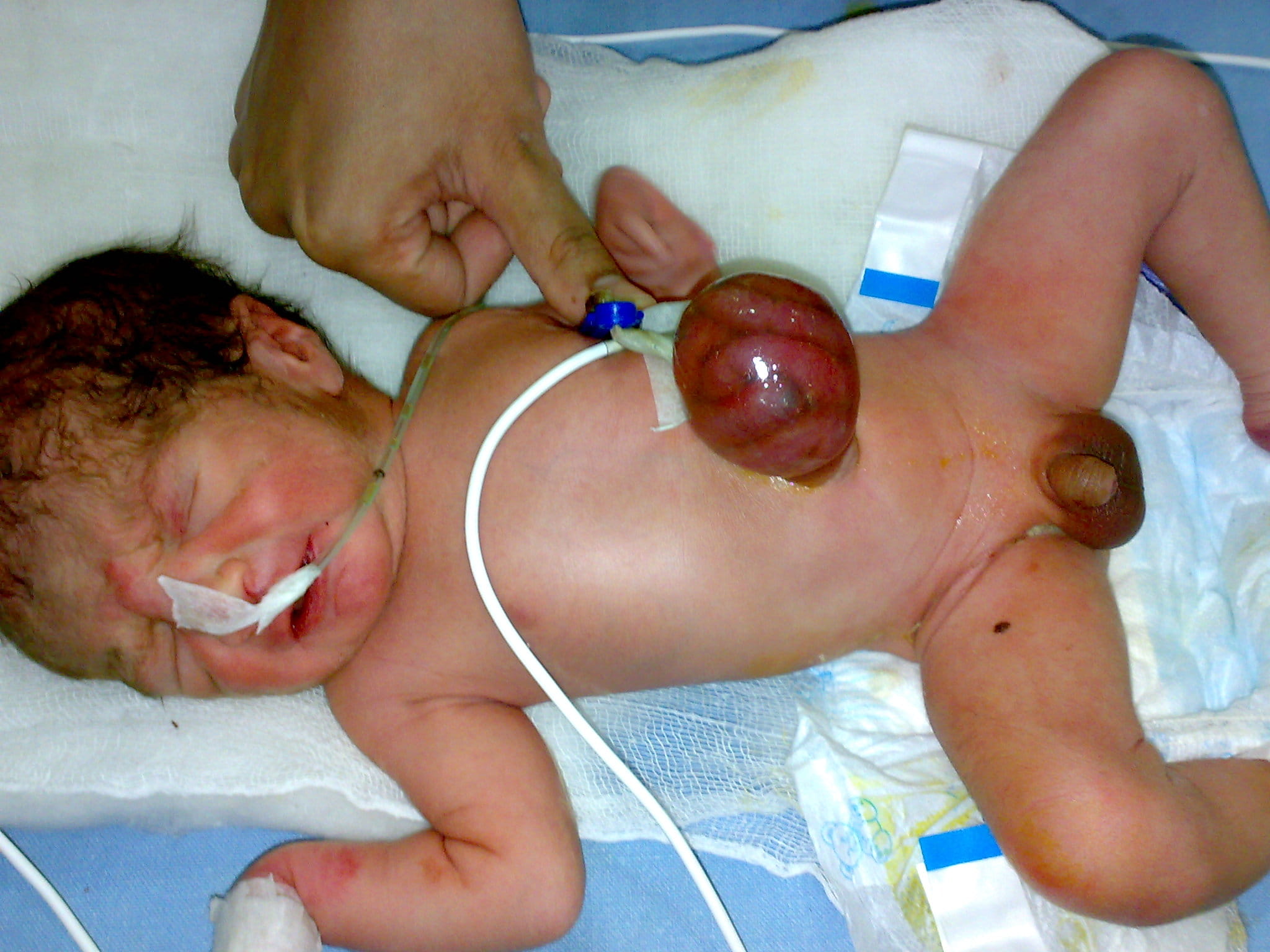
What is Exomphalos?
Exomphalos is a type of abdominal wall defect. It occurs when a child’s abdomen does not develop fully while in the womb. Early in all pregnancies, the intestine develops inside the umbilical cord and then usually moves inside the abdomen a few weeks later. In exomphalos, the intestines and sometimes other organs such as the liver, remain inside the umbilical cord but outside the abdomen.
What causes exomphalos?
We do not know what causes exomphalos, although we do know that it is becoming more common. Exomphalos can be associated with other problems, but doctors will examine children closely to check if this is the case.
What are the signs and symptoms?
Exomphalos is immediately recognisable because the child’s intestines are outside the body and covered in a membrane. The size of the bulging membrane containing the intestines and other organs varies from a small protrusion to quite a large lump.
There are two types of exompahlos: exomphalos minor where the opening is less than 4cm and only containing the intestine, and exomphalos major where the opening is greater than 4cm and/or with the liver inside the cord.
How is it diagnosed?
In many cases, exomphalos is visible on prenatal ultrasound scanning, which is useful because it gives time for discussions and planning for when and where to give birth. Generally children are born naturally (vaginal childbirth) but some, especially if they have a very large exomphalos, may need a caesarean section.
How is it treated?
Exomphalos is a serious condition so needs prompt treatment soon after birth. Children born with exomphalos are usually transferred to Great Ormond Street Hospital (GOSH) within a few hours of birth.
Immediately after birth, if the membrane covering the intestines is intact, the child will be kept warm and hydrated until they are transferred to GOSH, either to our intensive care unit or another of our specialist wards.
Depending on the size of the exomphalos, the infant may need to have it repaired in one operation or in several stages. If the exomphalos is small and the child is stable, they may have an operation soon after transfer, where the surgeon replaces the contents back inside the abdomen and closes up the base of the umbilical cord.
If the exomphalos is larger, contains the liver and/or the child needs to be stabilised, doctors may place a silo or pouch over the intestines, which is closed over a period of days to weeks, to allow the child to grow so that there is room inside the abdomen.
What does the operation involve?
If the child is having a one-stage repair under general anaesthetic, the surgeons will replace the child’s entire intestine into the abdominal space and close up the hole at the base of the umbilical cord.
Sometimes, they may need to use a ‘patch’ of material if the hole is quite large. They will cover the area with a dressing to protect the wound while it heals.
In a staged repair, there is too much intestine outside of the abdomen to put back without causing further damage or the space inside the abdomen is too tight. While the child is under general anaesthetic, the surgeon will make a mesh sac and put it over the intestine which keeps it contained and protected.
Occasionally, it is not possible to safely enclose all of the intestine inside the abdomen. If this is the case, the patch will be left in situ and the skin allowed to heal over the affected area forming a ‘hernia’, which will need treatment at a later date.
Any risks with the operation?
All surgery carries a small risk of bleeding during or after the operation. During the operation, the surgeon will minimise any bleeding by sealing off the blood vessels affected. There is a very small chance that nearby structures in the abdomen could be damaged during surgery but this is a very rare occurrence.
Every anaesthetic carries a risk of complications, but this is very small. The anaesthetist is a very experienced doctor who is trained to deal with any complications.
It can take a while after the operation for the intestine to start working properly so children may need to be fed intravenously using total parenteral nutrition (TPN) for a while. This affects many children and is explained further in the next section.
Some babies with exomphalos have breathing problems which may require more support for a longer period.
Any alternatives to the operation?
No. Abdominal wall defects need to be repaired to prevent fluid and body heat loss from the exposed intestines and reduce the risk of damage. Ultimately, the condition needs to be treated to allow the child to grow and develop.