
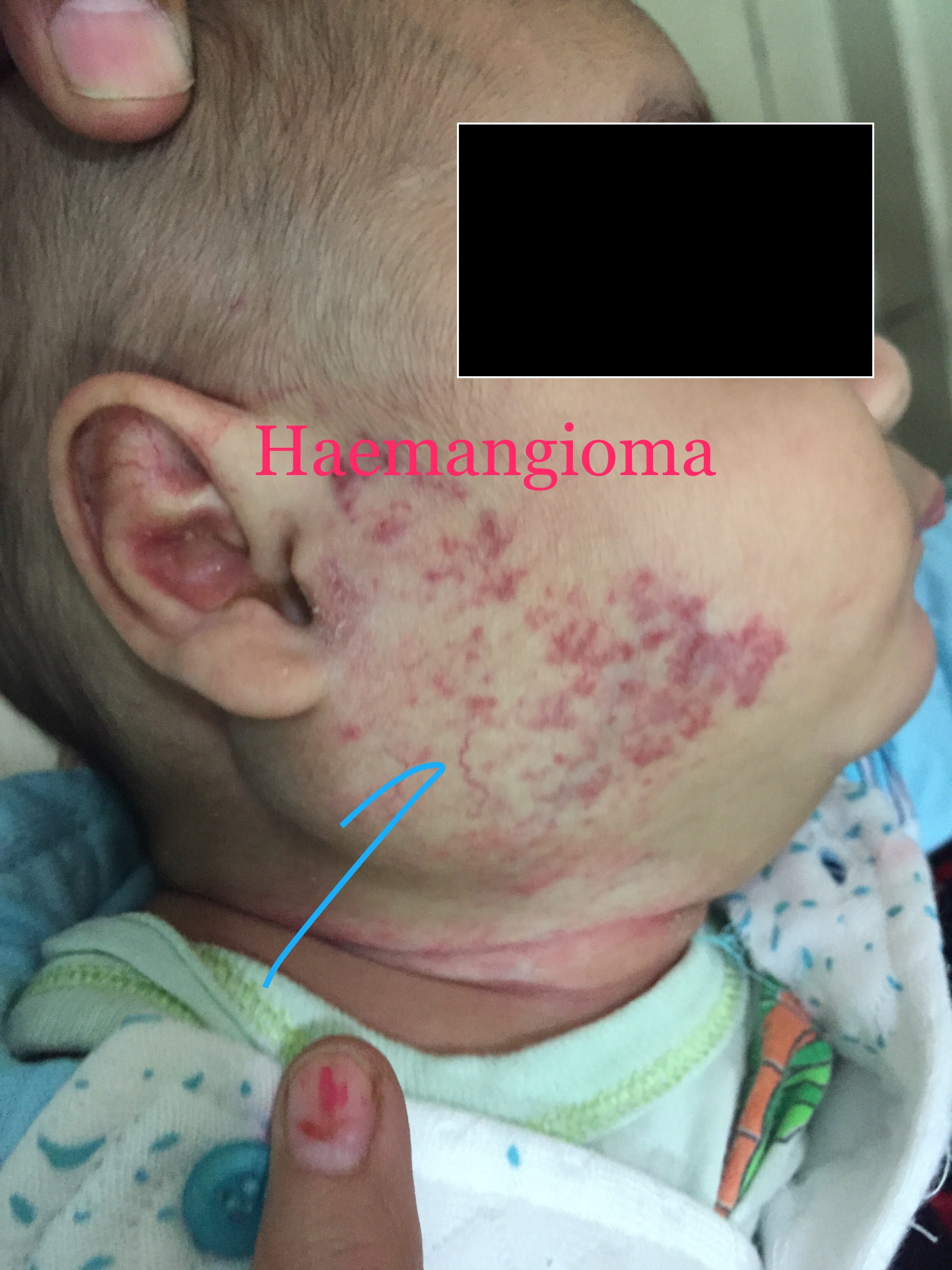
What is haemangioma?
A haemangioma is a type of benign (non-cancerous) tumour in infants. This abnormal cluster of small blood vessels appears on or under the skin, typically within one to three weeks after birth.
Often, there is no mark or only a faint birthmark on the skin that brightens in colour and increases in size over the baby’s first 2-4 months of life (proliferative phase).
The area then stabilizes in size and colour and then starts to fade and shrink (involution phase). Most haemangiomas are gone by 3 to 5 years of age. Some may cause residual areas of extra skin or small blood vessels called telangiectasias.
Premature infants are more likely to have a haemangioma.
Symptoms & Causes
What are the symptoms of haemangiomas in children?
Haemangiomas appear as a red birthmark within one to three weeks after birth. During the first six months of life, they may grow in size and protrude from the skin, and many eventually fade and disappear. Some haemangiomas present as deep lesions under the skin and may not be noted until later.
Skin haemangiomas may appear anywhere on a baby’s body. Common locations include:
- face
- chest
- scalp
- back
The size and colour of your child’s haemangioma depends on what type it is.
What causes haemangioma in children?
Haemangiomas are rarely hereditary. There are no known food, medication or activity during pregnancy that causes a baby to develop a haemangioma.
Diagnosis & Treatment
How is haemangioma diagnosed?
In most cases, the physician will be able to diagnose your child’s haemangioma simply by looking at it and reviewing the clinical history with the parent or caregiver.
If more information is needed to confirm your child’s diagnosis, the physician may request an ultrasound to examine the size of the haemangioma and allows your doctor to see how much blood is flowing through it.
Most haemangiomas go away by age 3 to 5 and do not require much treatment. Your child’s physician will recommend treatment if the haemangioma:
- obstructs vital functions like breathing or vision due to its location
- becomes infected or starts to bleed
- distorts a child’s facial or other body features
- is associated with other conditions that may be harmful to the infant
Treatment typically starts with medication management, which can slow the growth of a haemangioma and even shrink it.