
Duodenal Atresia
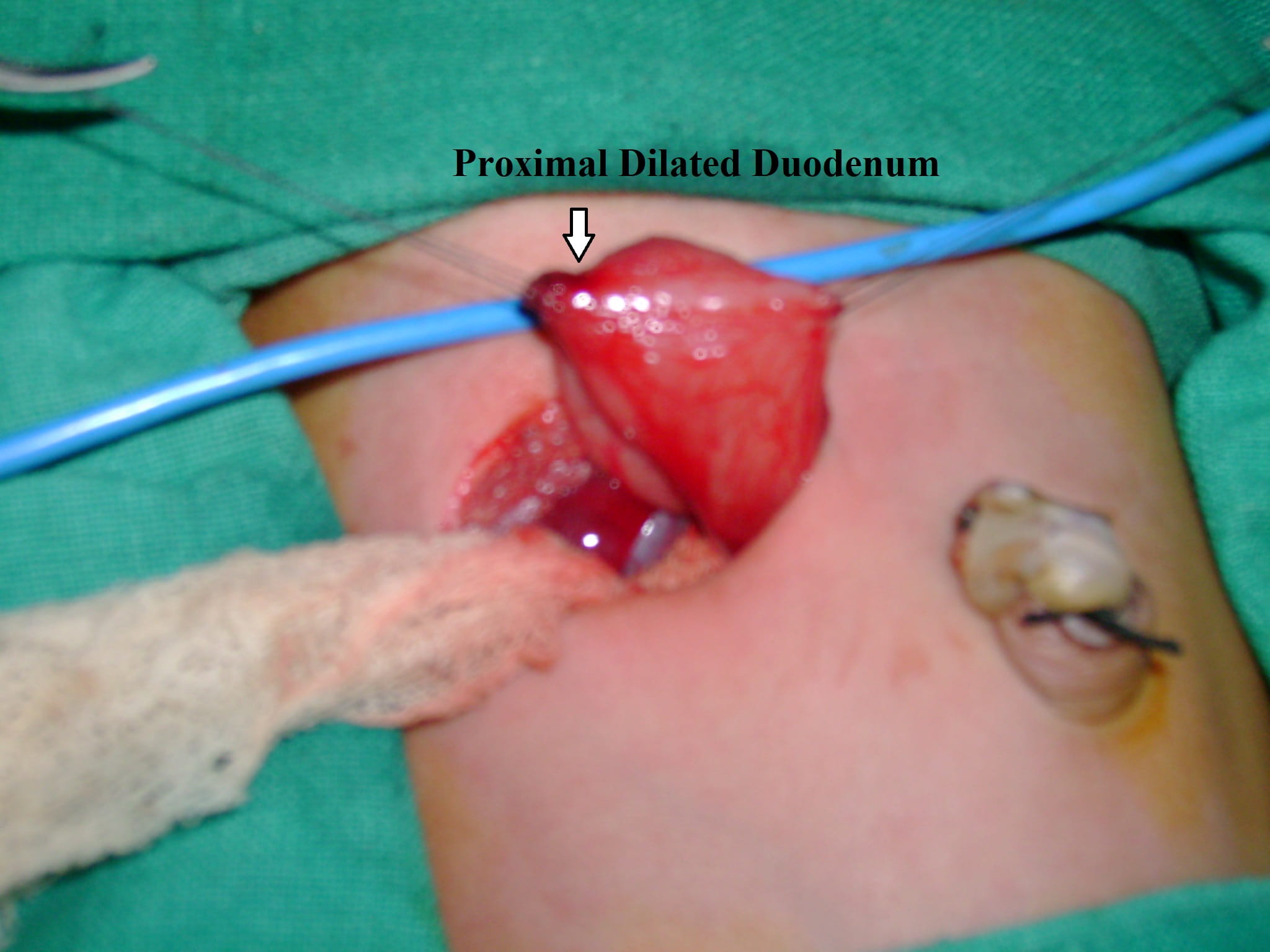
Duodenal atresia occurs in the duodenum and causes a blockage. The duodenum is the bowel adjoining the stomach. Atresia means gap. Occasionally there may not be a complete atresia but a partial narrowing or a diaphragm with hole instead. Duodenal atresia can be diagnosed on a ultrasound scan antenatally. This is a rare condition; the incidence is thought to be around 1 in 10,000 births. There is no known cause for this, but it is believed to have occurred sometime during the early weeks of pregnancy.
The diagnosis is made by seeing two fluid filled areas in the baby’s abdomen which are the dilated stomach and duodenum. This is referred to as the 'double bubble' of duodenal atresia. This may have been detected on an antenatal scan or may not be detected until after the delivery when the baby starts to vomit. Duodenal atresia can result in an increase in the amniotic fluid around the baby (known as polyhydramnios) which may lead to an early delivery. Duodenal atresia can be associated with other abnormalities. Approximately one third of babies with duodenal atresia have a chromosomal condition known as Down’s Syndrome and it is possible to test for this antenatally. Other investigations may be necessary after the baby is born.
Initial management
Babies with duodenal atresia vomit soon after birth and the vomit is usually bile-stained (green), after which:
- milk feeds, if started, will be stopped.
- a tube will be passed through the nose into the stomach to drain away any fluid and air collecting in the stomach.
- fluids will be given through a vein (drip).
How is the diagnosis made?
An X-ray of the baby’s tummy will confirm the diagnosis. Very occasionally it may be necessary for your baby to have another X-ray to confirm the diagnosis.
What’s the treatment?
An operation will be necessary in the first few days of life. The surgery is carried out through a small incision on the baby's abdomen. The two ends of the duodenum are joined together and the incision closed again. The same surgery can be done with minimally invasive technique in selective babies. Your baby will be kept comfortable with pain killers as required.
When can I feed my baby?
In babies with this condition it usually takes 5-7 days before the bowel is able to tolerate milk feeds, although in some babies it may be longer than this. The surgeon may decide to place a feeding tube down through the baby's nose, into the stomach and through the join in the duodenum so that milk feeds may be started earlier. This is called a trans anastomotic tube. However some babies will need drip feeds (parenteral nutrition) through a long line. This line is usually placed in a small vein in an arm or leg and fed through into a large vein. Sometimes an operation under anaesthetic is necessary to insert the line directly into a large vein. It should be possible for the baby to grow quite normally on this form of feeding while the bowel is recovering. Milk feeds will be slowly introduced and increased, as the baby is able to tolerate them. Once recovery has begun the baby should be able to feed normally.
What are the long term effects?
Usually there are no long term effects of duodenal atresia. However, following an operation, there is always a small risk of future obstruction occurring. If your baby has a bilious vomit or a distended abdomen medical advice should be sought.
For how many days my baby will be admitted?
This depends on your baby's recovery from the operation as well as the length of time that is taken to achieve complete oral feeding. In most cases the stay is about 10 days.