
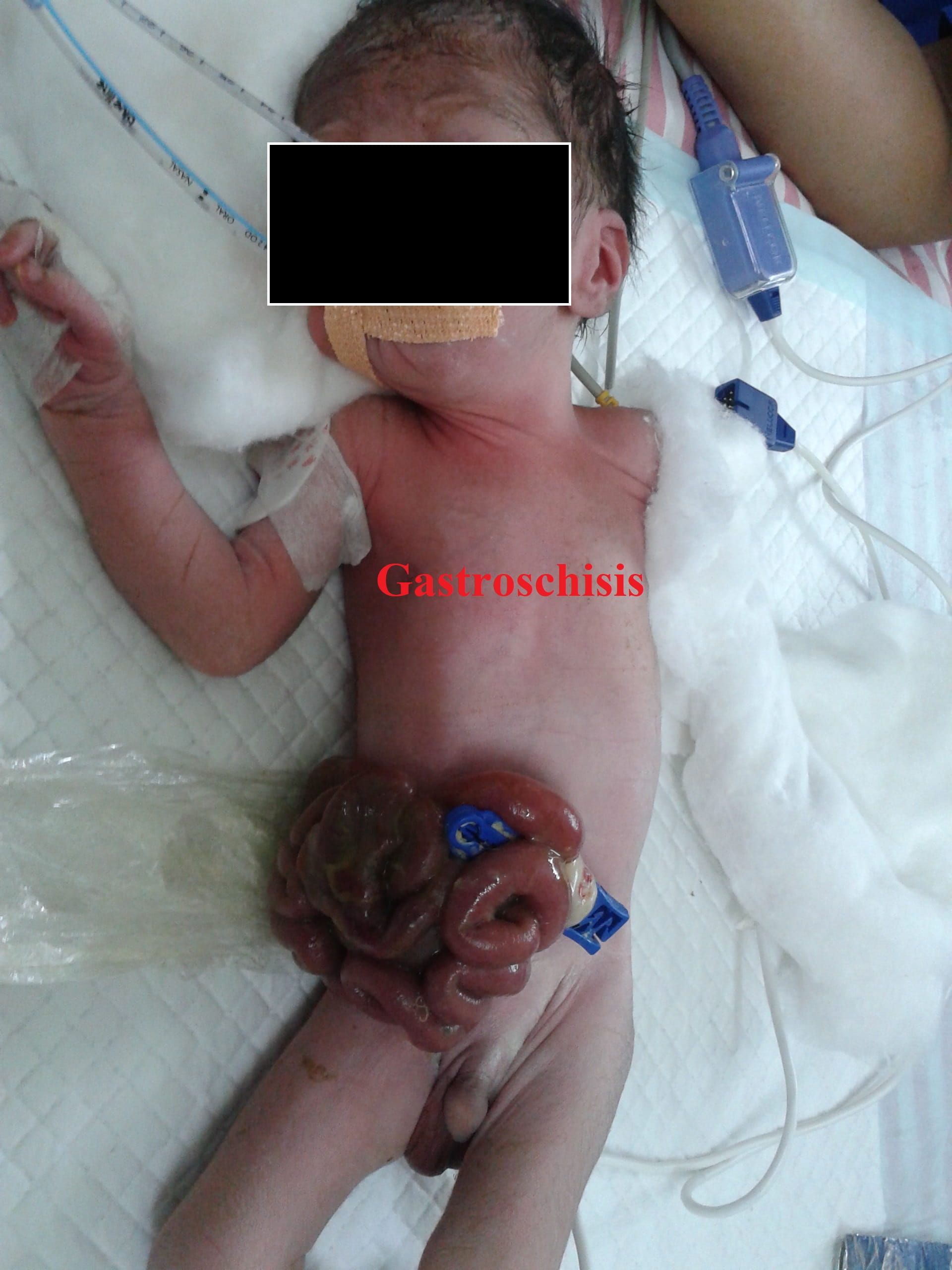
What Is Gastroschisis?
Gastroschisis is a birth defect that develops in a baby while a woman is pregnant. This condition occurs when an opening forms in the baby’s abdominal wall. The baby’s bowel pushes through this hole. The bowel then develops outside of the baby’s body in the amniotic fluid.
The opening is most often on the right side of the baby’s belly button. It can be large or small, but is typically 1 to 2 inches in size. In more severe cases, the stomach and/or liver can sometimes make their way through the opening as well.
Because the bowel is outside of the baby’s body, it is unprotected. That means there is a chance it can become irritated, swollen and damaged.
This condition is relatively rare, but has seen an increase in recent years. Gastroschisis occurs due to a weakness in the baby’s abdominal wall muscles near the umbilical cord. If your baby develops this condition during your pregnancy, you will not experience any symptoms related to it.
Gastroschisis can be repaired with surgery after your baby is born. It is usually not associated with other malformations.
What Causes It?
The exact cause of gastroschisis is not known. It does not appear to be inherited. Having one baby with gastroschisis does not make it more likely that you would have another baby with the condition.
Severity of Gastroschisis
Gastroschisis is labelled as simple or complicated. This is based on how inflamed the bowel and/or organs are that have moved through the opening.
With simple gastroschisis, only the bowel makes its way out of the abdominal opening.
With complicated gastroschisis, one or more of the following occurs:
- The bowel outside of the baby’s body is extremely damaged, e.g., a portion of the tissue has died (called necrosis), or the bowel has become twisted or tangled.
- Intestinal atresia, which occurs when part of the baby’s bowel doesn’t form completely, or the intestine is blocked.
- Other organs, such as the stomach or liver, protrude out of the opening as well.
Simple cases are more common than complicated ones.
Evaluation and Diagnosis
It is most commonly diagnosed by ultrasound around weeks 18-20 of pregnancy. In babies with gastroschisis, the ultrasound will show loops of bowel floating freely. This often shows up when a woman goes in for a routine ultrasound with her obstetrician.
Treatment Options
Any baby with gastroschisis must have surgery after birth. An infant cannot survive with his or her bowel outside of the body.
After your baby is born, doctors will assess how severe the gastroschisis is. The type of repair needed depends on how much bowel and/or organs are outside of your baby’s belly and any inflammation or damage to those tissues.
Primary Repair
With a simple gastroschisis, treatment often is what’s called a “primary repair.” This is a surgery where the bowel is placed back inside of the baby’s belly and the abdominal opening is closed. When possible, this surgery is done the day your baby is born. This type of repair is performed when there’s relatively small amount of bowel outside of the belly, and the bowel is not overly swollen or damaged.
Staged Repair
A primary repair might not be possible if:
- Your baby has a large amount of bowel outside the body
- The bowel is very swollen
- The baby’s belly doesn’t have enough room to hold all of the bowel
In these cases, several surgeries may be needed to slowly place the bowel / organs back into the belly. This is called a “staged repair.” This takes place over several days and can last up to two weeks. With a staged repair, a plastic pouch or “silo” is placed around the bowel and attached to the belly. Every day the silo is tightened and some of the bowel is gently pushed inside. When all the bowel is inside, the silo is removed and the belly is closed. Some babies may need the help of a breathing machine for a few days after the surgery or surgeries.
What does the operation involve?
If the child is having a one-stage repair under general anaesthetic, the surgeons will replace the child’s entire intestine into the abdominal space and close up the hole at the base of the umbilical cord. Sometimes, they may need to use a ‘patch’ of material if the hole is quite large. They will cover the area with a dressing to protect the wound while it heals.
In a staged repair, there is too much intestine outside of the abdomen to put back without causing further damage or the space inside the abdomen is too tight. While the child is under general anaesthetic, the surgeon will make a mesh sac and put it over the intestine which keeps it contained and protected.
Occasionally, it is not possible to safely enclose all of the intestine inside the abdomen. If this is the case, the patch will be left in situ and the skin allowed to heal over the affected area forming a ‘hernia’, which will need treatment at a later date.
Any risks with the operation?
All surgery carries a small risk of bleeding during or after the operation. During the operation, the surgeon will minimise any bleeding by sealing off the blood vessels affected. There is a very small chance that nearby structures in the abdomen could be damaged during surgery but this is a very rare occurrence.
Every anaesthetic carries a risk of complications, but this is very small. The anaesthetist is a very experienced doctor who is trained to deal with any complications.
It can take a while after the operation for the intestine to start working properly so children may need to be fed intravenously using total parenteral nutrition (TPN) for a while. This affects many children and is explained further in the next section.
Some babies with exomphalos have breathing problems which may require more support for a longer period.
Any alternatives to the operation?
No. Abdominal wall defects need to be repaired to prevent fluid and body heat loss from the exposed intestines and reduce the risk of damage. Ultimately, the condition needs to be treated to allow the child to grow and develop.
Prognosis
Babies with gastroschisis are usually smaller than average. After birth, it can take some time for them to catch up developmentally. Long-term problems mostly occur in the very complicated cases. These can be related to feeding, bowel or infection issues.
Babies with gastroschisis can have very different experiences based on how severe each case is. They first must recover from their initial surgical repairs, become successful at feeding, and their bowel must heal. After that, most babies who had gastroschisis can go on to live a normal, healthy life without complications related to the condition.